Arthritis affects millions of people around the world. Two of the most common types are osteoarthritis (OA) and rheumatoid arthritis (RA). Both types often lead to knee pain. Exercising an arthritic knee may seem counterintuitive, but regular exercise can actually lessen — and even relieve — arthritis pain and other symptoms, such as stiffness and swelling. There are several reasons to exercise with knee arthritis:
- Exercise maintains the joint’s full range of motion.
- Exercise strengthens the muscles that support the joint.
- Strong muscles help the joint absorb shock.
Exercise doesn’t have to be hard to be beneficial. In fact, gentle, low-impact exercises are best for knee arthritis. They minimize stress on the joint as they increase its flexibility and strength.
Knee Arthritis: Exercising at home or work
The best knee exercises may be the ones you can do at home or even during a break at the office. They’re easy, effective, and convenient, and don’t require any special equipment. Do them slowly and gradually increase the number of repetitions as your muscles get stronger.
Afterward, be sure to do a few gentle stretching exercises to help prevent your muscles from tightening up. Consider exercising your knees every other day to give sore muscles a rest.
Leg raise (lying)
- Lie flat on your back on the floor or bed with your arms at your sides, toes up.
- Keep your leg straight while tightening your leg muscles, and slowly lift it several inches.
- Tighten your stomach muscles to push your lower back down.
- Hold and count to 5, then lower your leg as slowly as possible.
- Repeat, then switch to the other leg.
Exercise tip: Start with one set of four for each leg.
Why it works: This exercise strengthens the quadriceps, which are the large muscles on the fronts of your thighs that attach to your knee joints.
Hamstring stretch (lying)
- Lie on the floor or bed with both legs bent.
- Slowly lift one leg, still bent, and bring your knee back toward your chest.
- Link your hands behind your thigh, not your knee, and straighten your leg.
- Pull your straight leg back toward your head until you feel the stretch.
- Hold for 30 to 60 seconds, then slowly bend your knee and lower your leg back to the floor.
Exercise tip: Perform the stretch 1 time on each leg.
Why it works: This exercise stretches and strengthens your hamstrings, which are the muscles on the backs of the thighs that attach to the knees.
Half-squat
- Stand with your feet shoulder-distance apart and stretch your arms out in front of you.
- Slowly bend your knees until you’re in a half-sitting position. Hold on to a chair for balance, if necessary.
- Keep your back straight and chest lifted — don’t lean forward.
- With your feet flat on the floor, hold the position for 5 seconds, then slowly stand back up.
There should be no pain while performing this exercise.
Exercise tip: Do 10 repetitions, and slowly work up to three sets of 10.
Why it works: This exercise strengthens the muscles on the fronts and backs of your thighs, along with the gluteus.
One-leg dip
- Stand between two chairs and hold on to them for balance.
- Lift one leg about 12 inches and hold it out in front of you.
- Slowly, keeping your back straight, bend the other leg and lower your body a few inches, as if you were about to sit in a chair. Don’t cross the lifted leg in front of the bent leg.
- Hold for 5 seconds and straighten back up.
- Repeat and switch legs.
Exercise tip: Start with one set of four leg dips for both legs, and slowly work up to three sets.
Why it works: This exercise strengthens the muscles on the fronts and backs of your thighs, as well as your buttocks.
Leg stretch
- Sit on the floor with both legs out straight. Stabilize yourself with your hands on either side of your hips, and keep your back straight.
- Slowly bend one knee until it feels stretched, but not until it becomes painful.
- Hold your leg in that position for 5 seconds, then slowly straighten your leg out as far as you can, again holding for 5 seconds.
Exercise tip: Repeat and switch legs whenever one begins to tire, 10 times.
Why it works: This exercise also strengthens the quadriceps.
Straight-leg raise (sitting)
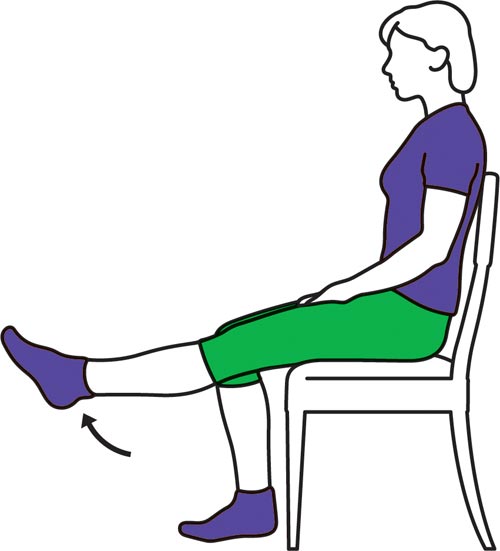
Sit back in your chair, with a straight back. Straighten and raise one of your legs. Hold for a slow count to 10, then slowly lower your leg. Repeat 10 times with each leg.
Muscle stretch
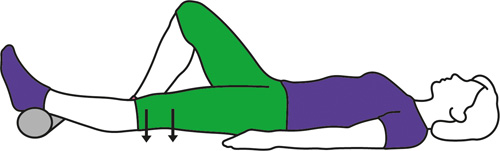
Lie down on your back with a rolled-up towel under the ankle of your leg. Bend the other leg at the knee. Use the muscles of your straight leg to push the back of your knee firmly towards the bed or the floor. Hold for a slow count of five.
Repeat at least five times with each leg. This exercise helps to prevent your knee from becoming permanently bent. Try to do this at least once a day when lying down.
Leg stretch
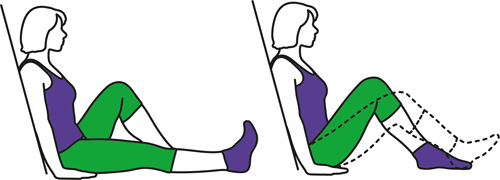
Sit on the floor with your legs stretched out straight in front of you. Slowly bend one knee up towards your chest, sliding your foot along the floor, until you feel a stretch. Hold for five seconds. Straighten your leg as far as you can and hold this position for five seconds.
Repeat 10 times with each leg. If you can’t get down onto the floor, sit on a sofa and use a board or tea tray as a surface to slide your foot along.
Straight-leg raise (lying)
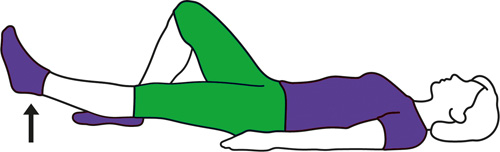
You can do this on the floor or lying in bed. Bend one leg at the knee. Hold your other leg straight and lift your foot just off the floor or bed. Hold for a slow count of five, then lower. Repeat five times with each leg every morning and evening.
Step ups
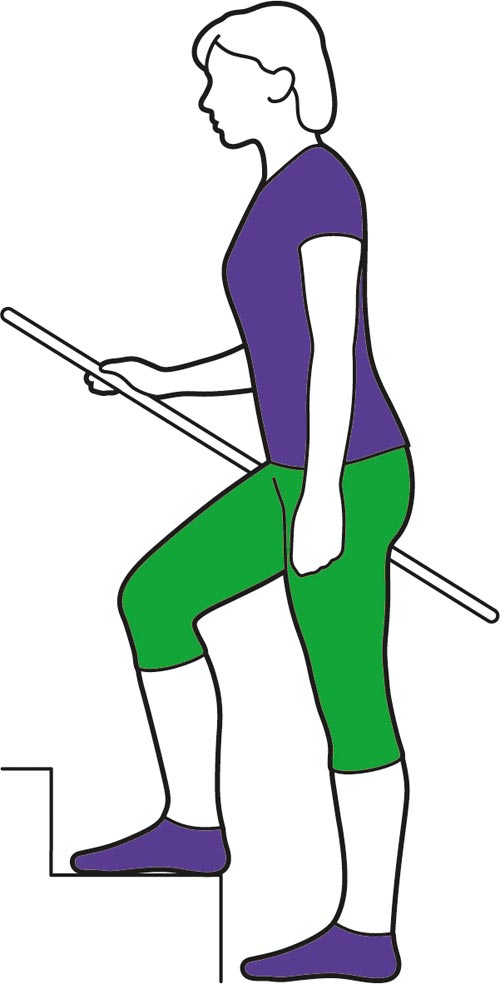
Step onto the bottom step of stairs with your right foot. Bring up your left foot, then step down with your right foot, followed by your left foot. Hold on to the bannister if necessary. Repeat with each leg until you can’t do any more. Rest for one minute and then repeat this another two times. As you improve, use a higher step, or take two at a time.
Sit/stands
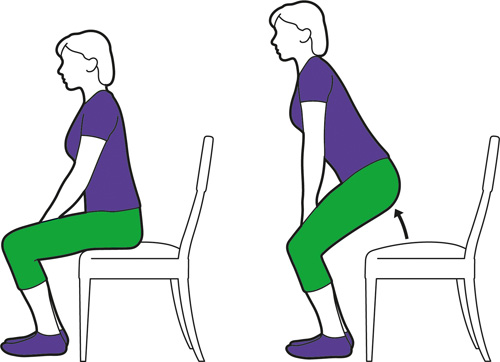
Sit on a chair. Without using your hands for support, stand up and then sit back down. Make sure each movement is slow and controlled. Repeat until you can’t do any more. Rest for one minute then repeat another two times. If the chair is too low, start with rising from a cushion on the seat and remove when you don’t need it anymore.
Quads exercise with roll
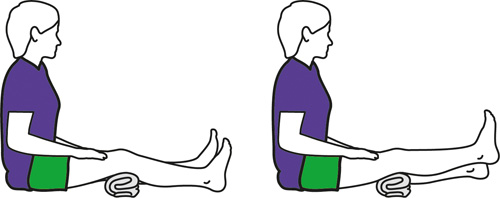
Sit on the floor, sofa or bed, with your legs stretched straight out in front of you. Put a rolled-up towel under one knee. Push down on the towel as if straightening your knee. Pull your toes and foot towards you, so that you feel your calf muscles stretch, and so that your heel lifts off the floor. Hold for 5 seconds, then relax for 5 seconds. Do this 10 times, then repeat the exercise with the other leg.
Leg cross
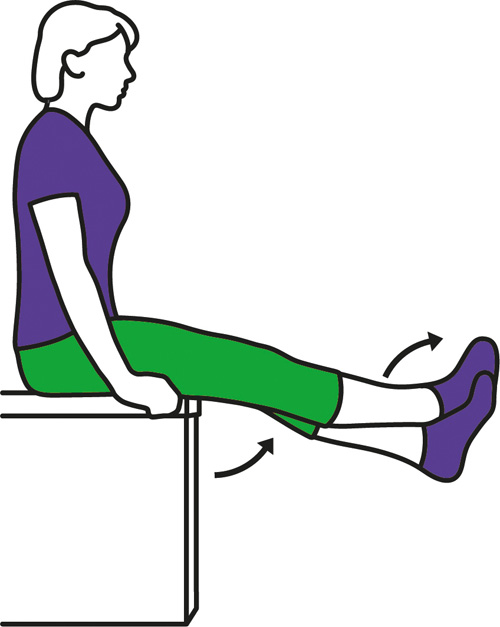
Sit on the edge of a table, seat or bed and cross your ankles. Push your front leg backwards and back leg forwards against each other until your thigh muscles become tense. Hold this for as long as you can, then relax. Rest for one minute and then repeat another two times. Switch legs and repeat.
Knee Arthritis: What other types of knee exercises work best?
Walking is an excellent form of exercise. It’s low-impact, and because it’s a weight-bearing exercise, it helps strengthen muscles and build bone. Wear good, sturdy shoes. Start out slow, and gradually increase your pace and distance for best results.
Water exercises or walking in the shallow end of a pool are also great for muscle strength and knee flexibility. Because the body is buoyant in water, it lessens impact to near zero as it makes you work a little harder to move.
Look for water exercise classes through your local Arthritis Foundation, community recreation center, or gym. Learn more about water exercises for arthritis relief.
Knee Arthritis: Before and after exercise
If you can, put a moist-heat pack on your arthritic knee for 20 minutes before you start exercising. Heat is soothing and it also brings the blood to the surface, decreases stiffness, and sometime relieves pain.
If you take pain medications, try taking them about 45 minutes before you exercise for increased pain control during your workout.
After exercising, put an ice pack on the sore knee for 10 to 15 minutes. This will help to bring down any swelling caused by exercise. It will also help to soothe and relieve pain.
What if it hurts?
Mild discomfort during exercise is normal. So is being a little bit sore the day after exercise. But if you experience severe pain, swelling, or stiffness, stop exercising the affected joint and see your doctor.
According to the Centers for Disease Control and PreventionTrusted Source, people with knee arthritis should do moderate exercise for at least 30 minutes per day, five days per week. You can even break it down into three 10-minute sessions each day, which works just as well.
You should experience better mobility and less pain within four to six weeks.


